
Informed Consent in Vulnerable Populations: The Case of Detained Persons with Attention Deficit Hyperactivity Disorder

Informed Consent in Vulnerable Populations: The Case of Detained Persons with Attention Deficit Hyperactivity Disorder

Research Article

Stéphanie Baggio, Leonel da Cunha Gonçalves, Patrick Heller, Hans Wolff, Laurent Gétaz

Journal of Empirical Research on Human Research Ethics, 8 May 2025

Abstract

Informed consent (IC) is a critical component in research involving human participants, yet participants’ understanding of consent information remains underexplored, particularly in vulnerable populations. This study aimed to assess whether attention deficit hyperactivity disorder (ADHD) was associated with understanding and willingness to sign the IC among detained individuals. This secondary analysis used data from a randomised trial conducted in a Swiss prison (n = 183). Statistical analyses included regression models. There was no significant difference in understanding of the IC between the groups with and without positive screening for ADHD (mean score = 5.2 vs. 4.9 respectively, p = .468). Acceptance of signing the IC was comparable between groups (83.3% ADHD vs. 84.9% non-ADHD, p = .814). Our findings suggest that ADHD did not significantly impair the understanding of the IC or the decision to participate in research among detained individuals. However, the level of understanding was overall low, highlighting the need for tailored approaches to improve understanding in vulnerable populations.
Complexities of competency and informed consent as applied to individuals with symptoms of Anosognosia

Complexities of competency and informed consent as applied to individuals with symptoms of Anosognosia
Nina M. Labovich
Cambridge University Press, 21 March 2025
Abstract
Anosognosia, commonly understood as a lack of insight, renders individuals with schizophrenia and schizoaffective disorder unable to understand that they are living with a disease, often resulting in a refusal to accept treatment. Typically, to impose involuntary commitment in an effort to obtain treatment, an individual must be a danger to others or themselves. Even if involuntary commitment is imposed, however, an individual may remain competent to refuse medication—despite symptoms of anosognosia and an inability to understand that they are ill. This article examines the existing legal theories of competency and informed consent and proposes a statutory definition of competency that encompasses the specific needs of people with anosognosia, while considering the significant interests at stake when taking away an individual’s right to choose or refuse treatment.

Informed Consent in Mental Healthcare

Informed Consent in Mental Healthcare
Book Chapter
Hanfried Helmchen, Jakov Gather
Ethics in Psychiatry, 20 March 2025 [Springer]
Abstract
The right to self-determination is firmly established in various national and international legal documents, as well as in declarations and codes of medical associations. Medical or research-related interventions can generally only be performed with the informed consent of the person concerned. In this chapter, we, firstly, describe the elements of informed consent and elaborate on the concept of shared decision-making and relevant aspects of the professional-patient relationship in mental healthcare. We then discuss why, what about, how, when and by whom patients with mental disorders should be informed and how decision support can be provided. We conclude by pointing out ethical conflicts which may occur in the context of informed consent, including situations in which patients lack mental capacity and, therefore, cannot give informed consent themselves.

An Assent Framework for People with Intellectual and Developmental Disabilities and Complex Communication Needs

An Assent Framework for People with Intellectual and Developmental Disabilities and Complex Communication Needs
Original Article
Christopher Tullis, Amarie Carnett
Journal of Developmental and Physical Disabilities, 8 March 2025
Abstract
In both research and practice, gaining assent from participants is an ethical imperative in applied behavior analysis. Recent guidance for including assent-based procedures has been provided in the literature (Breaux & Smith, 2023). However, limitations for decision-making when working with individuals who have developmental disabilities and complex communication needs (CCN) may require further guidance given the range of different considerations, such as use and proficiency with an augmentative and alternative communication system (AAC). Thus, this article provides an overview of considerations for individuals with greater support needs, a framework for evaluating assent in clinical practice, suggestions for measurement, and suggestions for future research.

The following article is referenced in the above:

Assent in applied behaviour analysis and positive behaviour support: ethical considerations and practical recommendations
Review
Cassi A Breaux, Kristin Smith
International Journal of Development Disabilities,1 February 2023; 69(1) pp 111-121
Abstract
The term positive behaviour support (PBS) is used to describe the integration of the contemporary ideology of disability service provision with the clinical framework of applied behaviour analysis (ABA). Assent, the participation consent of those not legally able to consent, has gained recent popularity in the fields of ABA and PBS. The goal of assent-based ABA and PBS is a person-centered approach to assessment, intervention, and all other decision-making. In this model, the learner’s assent withdrawal for participation is honored, whether it be a vocal ‘no’ or a non-vocal expression of verbal behaviour. There is currently a limited subset of studies that mention or utilize assent with learners in ABA or PBS. The lack of published research can make assent-based practices seem to be a choice of the practitioner. The authors of this manuscript seek to further define assent, illuminate the necessity of assent-based practices, and offer assent-based procedures in ABA- and PBS-based intervention.

Re-envisioning autonomy: From consent and cognitive capacity to embodied, relational, and authentic selfhood

Re-envisioning autonomy: From consent and cognitive capacity to embodied, relational, and authentic selfhood
Editorial
Jonathan Lewis
Clinical Ethics, 24 February 2025
Excerpt
… In medical ethics, autonomy at its most basic level has tended to be conceptualized in terms of a patient’s ability to understand, deliberate, and decide. Prevailing legal and ethical paradigms have long held that a patient’s expressed preferences—assuming they satisfy the requisite threshold of mental capacity—ought to be respected unequivocally. This model underpins practices such as advance directives, a framework critiqued by Brock for its narrow focus on cognitive capacity. Empirical findings reported by Toomey et al. suggest that lay judgments about decision-making do not align neatly with this capacity-centric model. Their research indicates that when tasked with deciding for another, individuals are inclined to privilege a person’s treatment preference even when the person fails to satisfy the traditional cognitive requirements for capacity so long as the preference reflects the person’s “true self.” According to Strohminger, Knobe, and Newman, the true self consists of those stable, core attributes—values, traits, and dispositions—that consistently define who a person is across time and circumstance. Their research demonstrates that individuals tend to regard actions as more authentic when they are consistent with these enduring, core attributes (rather than reflecting transient states or external pressures). If we, like most theorists of autonomy, consider authenticity to be a key component of the nature of autonomy, then Toomey et al.’s studies could suggest that a decision may not be genuinely autonomous if it does not resonate with these enduring aspects of the self. In other words, and in the context of medical decision-making, a patient’s choice might satisfy the formal criteria for cognitive capacity but still be considered non-autonomous if it deviates from what is widely recognized as the individual’s deep-seated values, interests, and dispositions (see, e.g., Hawkins and Toomey et al.)…

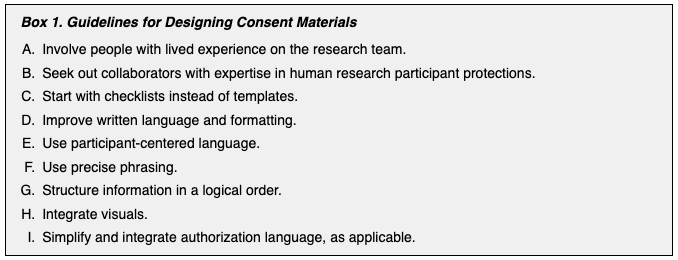
Guidelines for the Creation of Accessible Consent Materials and Procedures: Lessons from Research with Autistic People and People with Intellectual Disability

Guidelines for the Creation of Accessible Consent Materials and Procedures: Lessons from Research with Autistic People and People with Intellectual Disability
Research Article
Kelly B. Beck, Kristen T. MacKenziem, Anne V. Kirby, Katherine McDonald, Ian Moura, Kaitlyn Breitenfeldt, Elizabeth Rutenberg, Tanvi Kumar, Juliet Mancino, Maya Sabatello, Shannon Roth, Christina Nicolaidis
Autism in Adulthood, 19 February 2025
Abstract
Informed, voluntary, ongoing consent is a central tenet of ethical research. However, consent processes are prone to exclusionary practices and inaccessibility. Consent materials are often too long and complex to foster understanding and ensure that people make truly informed decisions to participate in research. While this complexity is problematic for all people, these challenges are compounded for autistic people and people with intellectual disability. Consent materials and procedures rarely incorporate accommodations for processing and communication differences common in autism and intellectual disability. Failure to provide such accommodations ultimately threatens the conduct of ethical research. We describe lessons learned across multiple major U.S. research institutions that improved informed consent materials and procedures, with the goal of fostering responsible inclusion in research for autistic people and people with intellectual disability. We used these alternative materials and procedures in multiple research projects with samples of autistic people and people with intellectual disability. Each contributing team partnered with university human research participant protections personnel, accessibility experts, community members, and researchers to develop rigorous procedures for improving the readability and accessibility of informed consent materials. We present guidelines for designing consent materials and procedures and assert that participatory methods are vital to the success of ongoing accessibility initiatives. Adoption of understandable consent materials and accessible consent procedures can cultivate more equitable, respectful, and inclusive human research practices. Future work should expand on this work to design inclusive practices for populations with additional considerations.

Navigating Methodological Challenges and Informed Consent in Pediatric Research: A Scoping Literature Review

Navigating Methodological Challenges and Informed Consent in Pediatric Research: A Scoping Literature Review
C Van Isterdael, Z Claessens, I Huys
Value in Health, December 2024
Abstract
Objectives
In the European health policy space, unmet medical needs are increasingly recognised as essential factors to steer pharmaceutical research and development towards a patient-centred healthcare system. However, the needs of challenging populations, such as paediatric patients, are often overlooked, resulting in substantial unmet needs. This study aims to provide an overview of challenges reported in literature on unmet health related needs in paediatric patients, as well as informed consent forms (ICFs) used in paediatric research.
Methods
This scoping literature review is a case study on paediatric blood cancer patients, following the PRISMA extension for scoping reviews. Two databases were included, PubMed and Embase. Descriptive data as well as qualitative data on methodological challenges and quantitative data on ICF was obtained from the included articles.
Results
In total, 52 articles were included for analysis. Methodological challenges in research on paediatric patients can be categorised by research stage. During recruitment, obtaining a representative sample can be challenging. Moreover, regarding data retrieval, discrepancies may arise between parent and child perspectives and researchers must be aware of parental dominance when interviewing children. Lastly, distinguishing development and disease-related changes can be challenging. ICFs were analysed in relation to the patients’ ages. In studies addressing minors, there was a tendency to involve adolescents rather than younger children. In most cases, parental informed consent (IC) was obtained, complemented with patients’ assent or IC. When studies focused on the needs of younger children, parents typically served as the respondents, either alone or with their child. In the latter case, an equal number of studies obtained IC from parents alone and complemented with the patients’ IC or assent.
Conclusions
This study provides an overview of methodological challenges and ICFs used in studies regarding research on identifying unmet health related needs in paediatric patients.

Decisional Capacity to Consent to Treatment in Children and Adolescents: A Systematic Review

Decisional Capacity to Consent to Treatment in Children and Adolescents: A Systematic Review
Review Article
Giovanna Parmigiani, Marcello Benevento, Biagio Solarino, Anna Margari, Davide Ferorelli, Luigi Buongiorno, Roberto Catanesi, Felice Carabellese, Antonio Del Casale, Stefano Ferracuti, Gabriele Mandarelli
Psychiatry Research, 25 December 2024
Abstract
Obtaining informed consent in vulnerable populations like children and adolescents, is a relevant issue and raises ethical concerns. Minors are considered unable to consent to treatment, and permission from guardians is required for them. Nevertheless, several studies have been carried out on the competence of pediatric patients, with mixed results. Following PRISMA guidelines, a systematic review was performed to assess children and adolescents’ decisional capacity to consent to treatment. The search strategy identified 2,790 studies, including 10 that survived full-text screening and evaluation. Studies included in the analysis evaluated the decision-making capacity of minors using the MacArthur Competency Assessment Tool – Treatment (MacCAT-T), the Adolescent Psychiatric Patient Competency Questionnaire (CQ-ChP); the Measure of Competency (MOC), the Measure of Competency- Hypothetical (MOC-Hyp). Overall, minors over the age of 13 showed an acceptable decisional capacity. However, further research, preferably on larger groups, is needed to shed more light on this topic.

Modifying Informed Consent to Help Address Functional Unmasking in Psychedelic Clinical Trials

Modifying Informed Consent to Help Address Functional Unmasking in Psychedelic Clinical Trials
Special Communication
Michelle Matvey, D. Parker Kelley, Ellen R. Bradley, Winston Chiong, Aoife O’Donovan, Josh Woolley
JAMA Psychiatry, 8 January 2025
Abstract
Importance
There is unprecedented clinician, industry, and patient interest in the therapeutic development of psychedelic drugs. This is due to a combination of promising clinical trial results, positive media coverage, and the lack of novel pharmacologic treatments for psychiatric disorders in recent decades. However, the field faces a key methodological challenge: masking participants to treatment conditions in psychedelic clinical trials has been largely unsuccessful.
Objective
When participants can tell whether they received active drug or placebo, their responses to clinical assessments, questionnaires, and even their functional imaging and biological data can be influenced by preconceptions about treatment effects. Positive patient expectancies combined with ineffective masking may skew outcomes and inflate effect sizes. This complicates efforts to determine the safety and efficacy of psychedelic drugs. Here, we explore a method to help address this problem: modifying informed consent to obscure information about the study design.
Evidence Review
We reviewed all contemporary (2000-2024) clinical trials of psychedelic or methylenedioxymethamphetamine (MDMA) therapy and corresponded with the investigators to compile information on the use of modifications to informed consent in these studies.
Findings
Modifying informed consent to obscure details of the study design has been implemented in several psychedelic clinical trials and may offer a way to strengthen masking. However, this approach poses significant ethical risks. We examine examples of modifications used in the psychedelic literature, discuss the current regulatory landscape, and suggest strategies to mitigate risks associated with modified informed consent.
Conclusions and Relevance
Incorporating modified informed consent in future psychedelic clinical trials may improve interpretability and impact, but this has not been explicitly tested. Modifications to informed consent may not be appropriate in all cases, and risks to participants should be minimized by implementing appropriate guardrails.

Informed Consent in dementia research: how Public Involvement can contribute to addressing “old” and “new” challenges Provisionally accepted

Informed Consent in dementia research: how Public Involvement can contribute to addressing “old” and “new” challenges Provisionally accepted
Ana Diaz-Ponce, Cindy Birck, Angela Bradshaw, Jean Georges, Daphne Lamirel, Soraya Moradi-Bachiller, Dianne Gove
Frontiers in Dementia, 2025
Abstract
Informed consent is a critical ethical requirement in research, ensuring the protection of participants’ rights and promoting their well-being and autonomy. However, in dementia research, this process becomes particularly complex due to cognitive impairments and fluctuating capacity. While substantial work has been done to address these challenges, much of the literature on informed consent in dementia research has been shaped by the perspectives of researchers and healthcare professionals, with less focus on those with lived experience. This paper provides an overview of the perspectives of people with dementia and their carers resulting from Public Involvement activities organised by Alzheimer Europe. It builds on Alzheimer Europe’s previous work with the European Working Group of People with Dementia and draws on discussions held during a face-to-face meeting about Participant Informed Consent forms and processes used in two specific European projects. We highlight views and key concerns raised by people with lived experience regarding the informed consent process, including barriers and facilitators. In addition to ensuring understandability, the discussions emphasised the importance of promoting respect and autonomy, ensuring that the values and interests of people with lived experience remain central throughout the research process. This paper contributes to the ongoing dialogue on improving informed consent practices in dementia research, highlighting the need for continuous involvement and the inclusion of people with lived experience in shaping consent practices to address both old and emerging challenges (i.e. new types of research such as artificial intelligence and data sharing/re-use) in dementia research.