Annals Graphic Medicine – Patient-Informed Consent

Annals Graphic Medicine – Patient-Informed Consent
Anna Brand, MD; Linde Gao, MD; Alexandra Hamann; Sophia Martineck; Verena Stangl, MD
Annals of Internal Medicine, 9 April 2019
Information
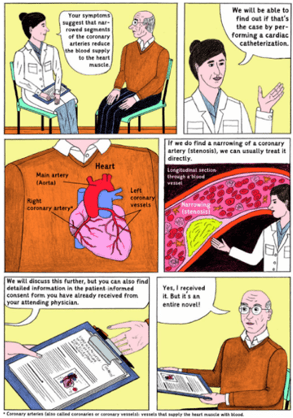
Medical graphic narratives to improve patient comprehension and periprocedural anxiety before coronary angiography and percutaneous coronary intervention: a randomized trial.

Editor’s note: The full graphic is available via open access at the link above. Below you will find a small excerpt.

Picture 1Picture 2

Medical Graphic Narratives to Improve Patient Comprehension and Periprocedural Anxiety Before Coronary Angiography and Percutaneous Coronary Intervention: A Randomized Trial

Medical Graphic Narratives to Improve Patient Comprehension and Periprocedural Anxiety Before Coronary Angiography and Percutaneous Coronary Intervention: A Randomized Trial
Anna Brand, Linde Gao, Alexandra Hamann, Claudia Crayen, Hannah Brand, Susan M. Squier, Karl Stangl, Friederike Kendel, Verena Stangl
Annals of Internal Medicine, 16 April 2019
Background
Written informed consent (IC) before such interventions as coronary angiography may not ensure that patients understand the rationale, procedural details, and potential risks involved. Barriers include patient anxiety, literacy, and differences in clinicians’ communication skills. Medical graphic narratives (“comics”) may communicate complex health information more clearly.
Objective
To assess whether supplementing standard IC (ICstandard) with a comic (ICcomic) improves patient comprehension, anxiety, and satisfaction.
Methods
From October 2016 to January 2018, a total of 135 consecutive hospitalized patients who were having coronary angiography at Charité – Universitätsmedizin Berlin, Campus Mitte, were screened for enrollment. Of these patients, 121 were randomly assigned to ICstandard (official consent form and conversation with physician) with or without ICcomic (graphic illustrations of central IC aspects based on the official consent form [available at www.annals.org/aim/article/doi/10.7326/G19-0008]); the same physician explained the procedure to all participants. After all participants completed ICstandard, the ICcomic group additionally received the patient comic…

Attitudes of postnatal women and maternity staff towards audio recording of consent discussions

Attitudes of postnatal women and maternity staff towards audio recording of consent discussions
Ivermee C, Yentis SM
Anaesthesia, 11 April 2019
Abstract
Audio recording consent discussions, and giving a copy of the recording to the patient to keep, might improve the consent process and reduce the risk of misunderstandings, complaints or medicolegal claims. However, there may be concerns over confidentiality and how being recorded could affect the consent discussion. We ascertained the views of 50 postnatal women and 100 maternity staff (25 anaesthetists, 25 obstetricians and 50 midwives) on making audio recordings of consent discussions. There was a wide range of opinions, with women and staff similarly supportive of audio recording overall, but the women were more supportive of recording than the staff when asked if they were against it, or whether they would support recording the discussion if the patient requested it; and less concerned than the staff regarding the potential disadvantages of audio recording. There were no significant differences in the views between anaesthetists, obstetricians and midwives.

Consent Plus: Improving the Consent Process in Elective Lower Limb Arthroplasty

Consent Plus: Improving the Consent Process in Elective Lower Limb Arthroplasty
Lee, A. P. Chandratreya
Orthopsedic Proceedings, 4 April 2019; 101B(3)
Abstract
Background of study
Following the Montgomery ruling, consent is now a matter of law. The medical professionals have to show proof that risks and implications and material risks are explained to the patient and that they have accepted to go ahead with surgery.
Materials and Methods
We devised a free web based programme (www.consentplus.com) which introduces a documented checkpoint to the consent process in hip and knee replacement surgery. It enables reproducible high-quality bite-sized information delivery to patients and their families in an optimal environment. It utilises the flip classroom principle to facilitate dialogue between doctors and patients. It generates physical documentation to show patients’ knowledge and understanding of the risks; to produce a truly informed consent.
Results
1567 users completed the Consent PLUS process over 28 hospitals across the UK. 98.1% of users were satisfied with Consent PLUS in terms of quality of service and information delivered. Users’ self-rated knowledge increased by 29%, independent of age group, prior knowledge or check-point scores. Supportive documentation for 100% of the users, which facilitated the consent process but did not replace the consultation. 60% of users accessed the system via desktop computers, 23% via tablet and 17% via mobile phone. 55 consultant surgeons and 28 hospitals have been registered into the system by the users. 96.9% of users found Consent PLUS useful and 96.3% would recommend it to their friends. 92.6% would use it again.
Conclusion
Consent PLUS can facilitate information delivery and improve patients’ understanding of the risks of surgery and its implications subjectively and objectively. Consent PLUS is a tool designed to enhance and facilitate the consent process, not to replace the current consent forms.

Editor’s Note: The mission statement of Consent PLUS as taken from the website on 17 April 2019 is as follows: “Consent PLUS has enabled the healthcare team to improve patient experience, save consultant time and standardise information delivery processes. Using Consent PLUS at the hospital in an access-controlled manner has enabled competent clinicians to give individual patients and their carers much more quality information about the procedure, including the material risks and benefit involved for that individual. From the healthcare provider point of view, it saves a considerable amount of time, checklist and videos help standardised the information delivery, rather than the clinician having to repeat them. The form is stored on the server and can be scanned back into the system once signed.”

Consent Recommender System: A Case Study on LinkedIn Settings

Consent Recommender System: A Case Study on LinkedIn Settings
Rosni K V, Manish Shukla, Vijayanand Banahatti, Sachin Lodha
Central Europe Workshop Proceedings, 18 March 2019; 2335 pp 53-60
Abstract
Privacy is an increasing concern in the digital world, especially when it has become a common knowledge that even high profile enterprises process data without data-subject’s consent. In certain cases where data-subject’s consent was taken, it was not linked to the proper purpose of processing. To address this growing concern, newer privacy regulations and laws are emerging to empower a data-subject with informed and explicit consent through which she can allow or revoke usage of her personal data. However, it has been shown that privacy self-management does not provide the expected results. This is mainly due to information overload as data-subjects use multiple services entailing variety of purposes, and hence, resulting in a very large number of consent requests. This may lead to consent fatigue as data-subject is now expected to provide informed consent for each associated purpose. The consent fatigue in data-subjects can lead to either incorrect decision making or opting for default values provided by the enterprise, and thus, defeating the purpose of new data privacy regulations. In this work, we discuss the factors influencing the informed consent of a data-subject. Further, we propose a ‘consent recommender system’ based on Factorization Machines (FMs) to assist the data-subject and thereby avoiding consent fatigue. Our consent recommender system effectively models the interaction between the different factors which influence a data-subject’s informed consent. We discuss how this setup extends for cold start data-subjects facing the decision problem with consent requests from multiple enterprises. Additionally, we demonstrate the scenario of consent recommendation as a prediction problem with minimum attributes available from LinkedIn’s privacy settings.

Informed consent (IC), randomized controlled trial digital vs conventional IC

Informed consent (IC), randomized controlled trial digital vs conventional IC
Galve La Hoz, J. Rioja, E. Salas, L. Enguita, M. Sanz Del Pozo, D. Corbatón, C. Gareta, S. Ezquerro, M. Muñoz, T. Cabañuz, P. Gil, M.J. Gil
European Urology Supplements, March 2019; 18(1) pp e847
Introduction& Objectives
In order to satisfy the informed consent process, patients must understand the information they receive. We know have support tools, like hyperrealistic simulations, which improve the understanding of informed consent. The objective of the study is to demonstrate that digital informed consent, with hyperrealistic simulations, improved the understanding of information and, therefore, informed consent.
Materials& Methods
The study included 84 participants who underwent a transurethral resection of the bladder, transurethral resection of the prostate or ureterostomy in our department. Participants were randomly assigned to either intervention or control group using the closed envelopes method. Informed consent was obtained in the outpatient clinic and patients were included in the study at hospital admission, when they were informed again. Intervention group watched a hyper realistic simulation from IURO app, consecutive, and completed a validated questionnaire. The control group completed the questionnaire without watching any simulation. The primary outcomes was subjective information perception. We used Mann-Whitney U test for statistical analysis.
Results
42 participants were assigned to each group. 4 participants in the intervention group did not complete the questionnaire versus 5 in the control group. Th intervention group, called digital consent, showed a higher subjective information perception than the control group, called the conventional group (figure 1 p= 0,001). The anxiety level in both groups was similar. In the subgroup analysis we observed that participants who had a basic level in the study or educational showed a higher subjective information perception in th digital group than the conventional group (p=0.006). We did not observe these differences in the subgroup with a higher level of study or educational.

Development of a Plain Language Decision Support Tool for Cancer Clinical Trials: Blending Health Literacy, Academic Research, and Minority Patient Perspectives

Development of a Plain Language Decision Support Tool for Cancer Clinical Trials: Blending Health Literacy, Academic Research, and Minority Patient Perspectives
Aisha T. Langford, Sarah T. Hawley, Sue Stableford, Jamie L. Studts, Margaret M. Byrne
Journal of Cancer Education, 9 February 2019; pp 1–8
Abstract
Despite the promise of clinical trials for improving cancer care, less than 5% of all cancer patients participate. Racial/ethnic minorities continue to be underrepresented in cancer clinical trials (CCTs). To address this gap, we developed a plain language, web-based decision support tool (CHOICES DST) in English and Spanish to support decision-making about CCTs among Blacks and Hispanics. In phase 1 (information collection), we conducted qualitative interviews with 45 cancer patients, completed a thorough literature review, and reviewed results from a telephone survey of 1100 cancer patients. In phase 2 (content generation), we created the first iteration of the CHOICES DST. In phase 3 (usability testing), we gathered user experience and acceptability data from a small sample of cancer survivors (n = 9). The Knowledge, Empowerment, and Values Clarification (KEV) model of decision-making was developed based on data from phase 1. The KEV model and other phase 1 data allowed us to create the CHOICES DST platform. Usability testing of the CHOICES DST showed highly favorable responses from users, satisfaction with content, ease of navigation, and a desire to use the tool. Qualitative results identified addressable points that would benefit from content and navigation-related alterations. The final version of the CHOICES DST was well received and understood by Black and Hispanic participants, and adheres to the mandates for plain language communication. This research provides preliminary data that CHOICES DST holds promise for improving knowledge of CCTs and potentially improving informed decision-making about participation in trials.